The Summer the Driveway Turned to Washboard
Across much of the United States, the warm months are grading season. Gravel driveways that drained well in spring develop ribbed washboard near the cattle guard, and ranch roads rut where runoff cut channels. Riding arenas pack into hard, uneven crusts, and equipment lots wash out at the low corners every time a thunderstorm rolls through.
Property owners who tried to fix these surfaces with a simple back-drag or a box blade often found the problem returned within weeks, and many eventually reached for a land plane instead, because the geometry of the tool does something a short blade physically cannot.
Understanding Why That Is True Means Looking at How Grading Equipment References the Ground in the First Place
It is less a question of horsepower than of geometry.
What Grade Reference Actually Means
Every grading tool has to answer one question: relative to what does it decide how deep to cut? That answer determines whether the surface gets smoother or simply gets dragged around.
A single blade or a back-drag bucket references the ground directly beneath it. When the cutting edge climbs a high spot, the machine tips up and the edge lifts; when it drops into a hollow, the edge dives. The blade traces whatever shape is already there, so washboard tends to be copied forward rather than erased.
This is the same reason a short ruler cannot tell you whether a floor is level. Rest it on two bumps and it rocks. You need a longer straightedge to bridge the high points and reveal the dips between them.
See also: Comprehensive Handyman Contractor Services: Transforming Homes with Skilled Work
Riding on the Average Grade
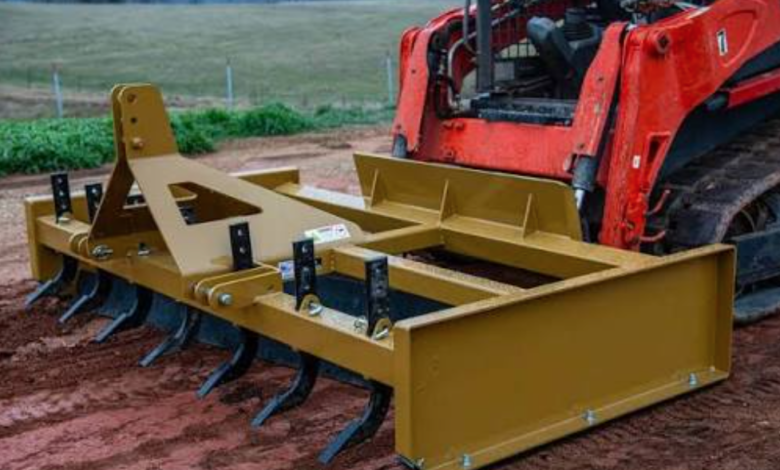
A land plane solves the reference problem with length. Its long, rigid frame rides on the average grade, bridging bumps and ruts the way a long straightedge spans a wavy floor. The cutting blades hang inside that frame at a fixed height relative to the average, not to the bump directly underneath.
The result is automatic. Where the frame bridges a high spot, the blade rides low against that rise and shaves material off the top. Where the frame passes over a hollow, the blade rides above it and the loosened material it is carrying drops in to fill it. High spots are cut, low spots are filled, and nobody had to aim either action.
This self-leveling behavior is the whole point. The longer the frame relative to the wavelength of the ruts or washboard, the more completely it averages them out. A short blade follows the bumps; a long frame ignores them and chases the mean. That difference in geometry is why one tool spreads a problem and the other erases it.
Why Compacted Ground Needs Ripping First
There is a catch. A blade can only shave a high spot if that high spot will actually shave. Sun-baked gravel, packed arena footing, and old road crowns can be hard enough that a flat blade skips across the surface instead of cutting in.
This is where scarifier teeth, sometimes called ripper teeth, come in. Mounted ahead of the leveling blades, these adjustable shanks bite into the surface and tear up the compacted crust first.
On the leading edge, a land plane carries six adjustable scarifier teeth for exactly this reason. Set them shallow for a light refresh of loose gravel, or drop them deeper to break a hardened crown before the blades go to work behind them.
Sorting Material as It Moves
Smoothing a surface is partly about cutting and partly about deciding what stays. A graded gravel road wants its fine material to bind into a tight, shedding surface, while oversize rocks that work to the top leave a rough, loose finish that ravels apart under traffic.
Sift-screen trays let size do the sorting. As material is dragged across the screen, fine particles fall through and settle back into the surface where they pack and bind. Oversize rock is too large to pass, so it rides along the screen and is carried off to the edge of the pass instead of staying embedded in the running surface.
A reversible planer comb adds flexibility. One orientation aggressively combs and tears loose material for heavier leveling; flipped, it gives a gentler finishing action for a smooth final pass. The same tool handles both the rough cut and the cleanup without changing equipment.
Classifying the Common Grading Tools
It helps to sort grading attachments by how each one references grade, because that trait predicts how it behaves on a rutted surface.
- Simple blade or back-drag: copies existing bumps, fast but poor at leveling
- Box scraper: carries dirt from cut to fill, but relies on operator feel
- Land plane: rides the average grade, self-levels ruts and washboard
None of these is universally best. A box scraper wins at bulk earthmoving from one elevation to another, and a simple blade wins for speed and for crowning. The long-frame tool wins when the goal is a smooth, even running surface, which is why it has become the default for driveway and road upkeep. Each tool, in other words, is matched to a task rather than ranked above the others, so the right choice begins with naming the job in front of you.
A Field Example from the Ranch Road
Consider a quarter-mile ranch road in the western United States with deep washboard on its grades and soft ruts in two low spots. A back-drag pass smoothed it for a day, then the washboard reappeared because the bucket had simply traced and re-pressed the ribs.
Switching to a 72-inch skid steer attachment changed the outcome. The scarifier teeth were dropped about two inches to tear the baked crust, the long frame then bridged the ribs and shaved the high points while loosened gravel filled the hollows, and the sift screens dropped fines back into the surface while larger rocks rode off to the shoulder.
Choosing Length for the Job
The practical lesson is to match the frame length to the surface you are fixing. Wide, gentle undulations need a longer reference to average them; tight washboard responds to almost any frame longer than its own wavelength. For most driveways, arenas, and ranch roads, a 72-inch working width on a skid steer balances reach and maneuverability.
For owners tired of regrading the same washboard every few weeks, the durable fix is usually a tool whose geometry does the leveling for them, and that is precisely what a land plane is built to do, turning a rutted, rough surface back into a smooth, even grade that lasts through the season.