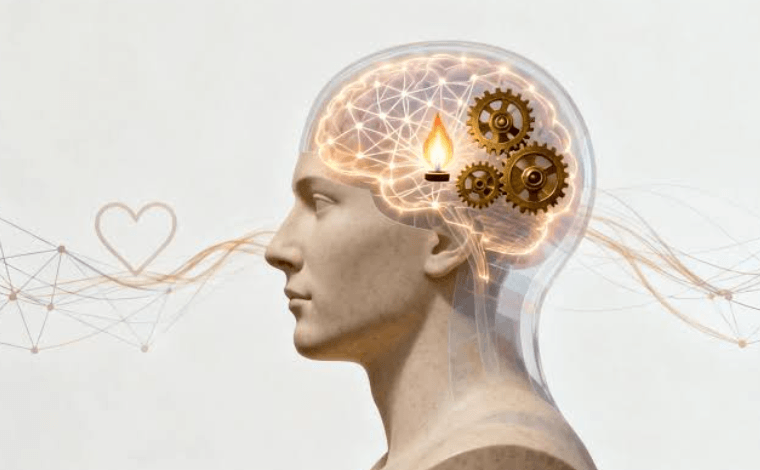
You feel your heart rate spike before a job interview. Your palms sweat before a difficult conversation. Most people assume the body is simply reacting to an emotion that already exists. But what if the relationship between your body and your feelings is far more complicated than that? Scientists and psychologists have been arguing about this question for over a century, and the answers have real implications for how people understand anxiety, stress, and emotional health.
This article walks through the leading scientific explanations for how emotions form, what the brain actually does during an emotional experience, and why getting clear on this process can help people develop stronger emotional awareness. Whether you are curious about psychology or actively working to improve your mental health, understanding the mechanics of emotion is a genuinely useful place to start.
Why Researchers Still Disagree About What Emotions Are
Emotion seems like one of the most personal, immediate experiences a person can have. So it might be surprising that psychologists have debated its basic definition for generations. Part of the difficulty is that emotions involve at least three distinct components: a subjective feeling, a physiological response in the body, and a behavioral reaction. Different theories emphasize different parts of that trio, which is why the debate has lasted as long as it has.
Early researchers tended to focus on the body. William James, writing in the late 1800s, proposed that people feel sad because they cry rather than the other way around. That claim sounds counterintuitive, but it generated decades of productive research. Later, psychologists began focusing more on the role of the brain and, eventually, on the role of thought itself. The shift toward cognition changed everything.
Major Theories of Emotion at a Glance
Comparing the major frameworks side by side makes it easier to see where they agree, where they diverge, and what each one contributes to the broader picture.
| Theory | Key Proponent(s) | Core Claim | Role of Cognition |
| James-Lange Theory | William James, Carl Lange | Emotions arise from awareness of bodily changes | Minimal |
| Cannon-Bard Theory | Walter Cannon, Philip Bard | Body and emotion are triggered simultaneously by the brain | Minimal |
| Two-Factor Theory | Stanley Schachter, Jerome Singer | Physiological arousal plus a cognitive label equals emotion | Central |
| Cognitive Appraisal Theory | Richard Lazarus | Appraisal of a situation determines the emotional response | Central |
| Constructed Emotion Theory | Lisa Feldman Barrett | Emotions are predictions built by the brain using past experience | Central |
Each of these frameworks has research supporting it, and none has been fully discredited. Most contemporary psychologists draw from several of them rather than committing to just one.
The Role of Cognitive Appraisal in Emotional Experience
One of the most influential shifts in emotion research came when psychologists began asking not just what the body does during an emotional experience, but what the mind thinks. Cognitive appraisal is the process by which a person evaluates a situation and determines whether it is relevant to their goals, whether it poses a threat, and whether they have the resources to deal with it. That evaluation, researchers argue, is what actually shapes the emotional response.
Consider two people stuck in a traffic jam before an important meeting. One person catastrophizes, imagining the worst-case professional consequences. The other accepts the situation as out of their control and focuses on what they can do. Both people face identical circumstances, but their emotional experiences will differ significantly. The difference comes from appraisal, not from the traffic itself.
This is the central insight behind the Lazarus theory, which holds that a cognitive appraisal of a situation must occur before any emotional response can take shape. Richard Lazarus argued that emotions are not automatic, reflexive reactions but are instead the result of an ongoing evaluative process. This perspective has had a lasting impact on cognitive behavioral therapy and stress research alike.
What Neuroscience Adds to the Picture
Brain imaging technology gave researchers a new way to study emotions without relying solely on self-reports. Early neuroscientific models pointed to the amygdala as the brain’s primary fear center, a small almond-shaped structure deep in the temporal lobe that responds rapidly to perceived threats. For a time, it seemed like the neuroscience supported the older, less cognitive theories. The amygdala fires before conscious thought can intervene.
But more recent research has complicated that story. Lisa Feldman Barrett, a neuroscientist at Northeastern University, argues that the brain is constantly making predictions about the world based on prior experience. Emotions, in her model, are not hardwired responses locked inside specific brain regions. They are constructed in real time, using stored memories, current sensory input, and the body’s internal state. Her work, summarized in her 2017 book “How Emotions Are Made,” challenges the idea that basic emotions like fear or joy are universal categories with fixed neural signatures.
This has practical implications. If emotions are partially constructed by the brain’s predictions, then changing those predictions through therapy, mindfulness, or new experiences could genuinely alter how a person feels. That is not a small claim.
The Mind-Body Connection Is a Two-Way Street
The old debate about whether the body drives emotion or the mind drives emotion may have been framed as a one-way question when the actual relationship is bidirectional. Research on interoception, which is the brain’s ability to sense and interpret signals from inside the body, suggests that people who are more attuned to their own physical states tend to have richer emotional awareness.
A study published in Nature Neuroscience in 2004 by Hugo Critchley and colleagues found that activity in the anterior insular cortex, a region involved in interoception, correlated with both emotional awareness and the intensity of emotional experience. People with stronger interoceptive awareness reported more vivid emotional states. This finding suggests that paying attention to bodily sensations is not just a therapeutic technique but is actually tied to the brain’s fundamental architecture for emotion.
This connection also helps explain why physical interventions, such as exercise, controlled breathing, and even posture changes, can shift a person’s emotional state. The body is not simply responding to the mind. It is also sending information upward that shapes how the mind constructs experience.
Practical Takeaways for Emotional Self-Awareness
Understanding how emotions form is not just an academic exercise. It has concrete applications for anyone working on their mental health or trying to build better emotional habits. Here are some ways the research translates into daily practice.
- Notice the appraisal before the emotion. When a strong feeling arises, ask what story you told yourself about the situation. That story is often where the real work is.
- Pay attention to physical sensations without immediately labeling them. Tension in the chest or shallow breathing is information, not a verdict.
- Recognize that emotional labels are not always accurate. The brain makes its best guess at naming what you feel, and that guess can be revised.
- Build a richer emotional vocabulary. Research by psychologist Marc Brackett at Yale suggests that people who can distinguish between similar emotional states, such as anxious versus disappointed, are better able to regulate those states.
- Be cautious about suppression. Studies consistently show that trying to push emotions away tends to amplify them rather than reduce them.
None of these practices requires a therapist’s office or a formal program. They are skills that can be developed incrementally through attention and intention.
See also: Future-Ready Pharmacy Management System for Healthcare with Healthray
Why This Matters for Mental Health
Anxiety disorders are the most common mental health condition in the United States. According to the National Institute of Mental Health, an estimated 31 percent of adults will experience an anxiety disorder at some point in their lives. Many of the most effective treatments for anxiety and related conditions work, at least in part, by targeting the appraisal process. Cognitive behavioral therapy teaches people to identify and challenge unhelpful interpretations of events. Mindfulness-based approaches build awareness of physical sensations and emotional reactions without automatic judgment.
The science of emotion is not a detached, theoretical concern. It sits directly underneath some of the most effective tools in mental health treatment. Knowing that emotions are shaped by evaluation, prediction, and bodily awareness gives people more than curiosity. It gives them agency.
Emotions are not mysterious forces that arrive without warning and leave without explanation. They are processes, shaped by the brain, the body, and the stories people tell themselves about the world. That means they can be understood, and to some meaningful degree, they can be shaped. For anyone on a path toward better emotional health, that is one of the most encouraging things science has to say.