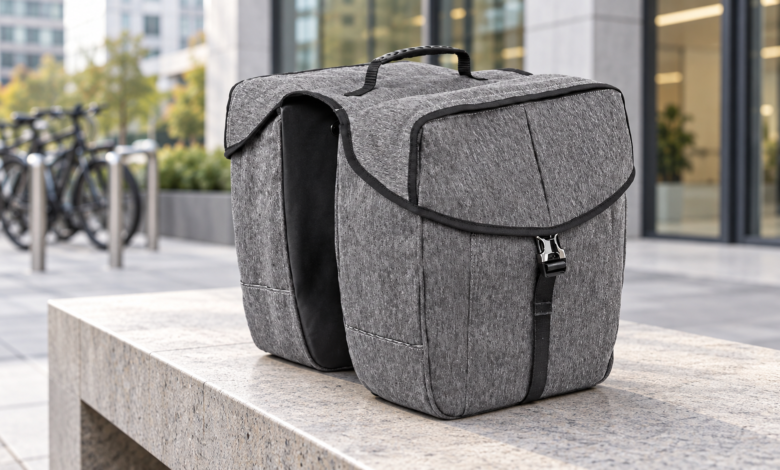
A good commuter bike bag stays secure on the bicycle, makes everyday items easy to find, and remains practical after you park. Weather protection matters, but so do the minutes spent loading it before work and carrying it through a lobby afterward. The right choice comes from matching the bag to that whole routine, rather than choosing whichever model has the most pockets or the largest capacity.
Start with an ordinary weekday load: work materials, lunch, a lock, an extra layer, and whatever you need for the return trip. Then consider the awkward moments. Perhaps your bicycle lives upstairs, your office has limited storage, or you stop for groceries. Those details reveal whether you need a removable pannier, a compact rack bag, or a bag you can comfortably wear.
Choose around your actual morning load
Lay out a typical load before comparing advertised liters. A rectangular lunch container, a laptop sleeve, and shoes occupy space differently from folded clothing. A bag can have enough total volume yet a narrow opening that makes the lunch container difficult to insert. Check the opening, base shape, and usable internal dimensions, with any organizer or padded insert installed.
Separate everyday capacity from occasional expansion. If you buy groceries once a week, a second removable bag may be more convenient than carrying a large half-empty bag every day. If your load changes little, a close-fitting organizer can keep essential items in predictable places. Decide what must stay upright, what needs cushioning, and what should remain separate from food before adding compartments.
Consider a commute that includes a laptop, a lunch box, and a spare shirt. A tall, narrow compartment might keep the laptop upright but force lunch above it, where removing either item disturbs the other. A wider base or separate removable organizer could solve that problem without increasing total capacity. This is why a physical packing trial is useful: it exposes conflicts between objects that look perfectly compatible when described only as a list of belongings.
See also: How to Balance Mom Life and Lifestyle: Tips for Maintaining Peace, Style, and Health
Treat the mounting system as part of the bag
A pannier depends on a compatible rack and attachment system. It should not simply hang from the top rail with its lower edge free to swing. Check how the upper fittings engage and how the lower attachment controls movement. Rack tubing, mounting positions, and the space beside the wheel all influence fit; a photograph of the empty bag tells you little about that relationship.
Check heel clearance with your normal shoes and the bag packed. REI specifically identifies heel contact as a problem when panniers are too large or mounted too far forward. [1] Move the pedals through a full rotation while the bicycle is securely supported, then test the arrangement in a quiet area. If repositioning compromises attachment, choose a different shape instead of accepting occasional contact.
Quick removal is useful, but the mechanism needs to suit your routine. Some designs keep the hooks on the bag; others leave a dedicated panel on the bicycle. Thule’s Shield InLock system is an example of the latter and requires its compatible panel. [2] This illustrates why checking what is included matters. A bag described as removable may still need additional hardware before it can attach to your rack.
| Bag format | Useful commuting role | Check before choosing |
|---|---|---|
| Single pannier | Work items or shopping carried off your back | Rack fit, heel clearance, and off-bike handle |
| Rack-top bag | Compact daily load with a broad opening | Rack platform, attachment, and usable height |
| Handlebar bag | Small essentials kept together | Cables, controls, steering, and wheel clearance |
| Cycling backpack | Frequent walking or a bicycle without a suitable rack | Loaded comfort and device organization |
| Convertible pannier | One bag for riding and longer walks | Where hooks and shoulder straps sit in each mode |
Make access predictable rather than complicated
Think in terms of when you need each item. A repair pouch belongs somewhere you can reach without unpacking clean clothing. An entry card should be available when you arrive, while a laptop can stay deeper inside during the ride. A few clearly assigned spaces often work better than many similar pockets that hide small items and reduce the main compartment’s flexibility.
External pockets trade convenience against exposure. A pocket that is handy for a folded map may be unsuitable for a phone in sustained rain. Check whether each compartment shares the main bag’s stated protection. Keep keys away from screens, place tools in a separate pouch, and choose an opening you can operate while stopped without holding the whole bag against your body.
For a product team, these small interactions belong in the development brief. A bike bag manufacturer needs to understand the rider’s load and sequence of use, not just a requested capacity and logo. Vancharli Outdoor’s bicycle-bag offering includes adjustments to mounting, dimensions, compartments, and branding. A useful starting brief therefore describes where the bag attaches, what goes inside, and how the rider carries it after parking.
Match weather protection to how you use the opening
A commuter bag encounters more than rain falling from above. Water can reach it from the road, and opening it outdoors creates a different exposure from riding with it closed. For frequent wet commutes, consider how easily you can close the bag correctly with your actual load inside. A closure that works only when the bag is nearly empty will be frustrating on a grocery run.
Follow the instructions for the particular model rather than assuming every roll-top works identically. For example, ORTLIEB specifies three to four rolls and a secured downward closure for the Back-Roller Plus to meet its stated IP64 protection. It also distinguishes that protection from full submersion. [3] These are product-specific conditions, not ratings that can be applied to every bag with a similar appearance.
Leave enough room to close the bag without forcing the fabric around a rigid object. Pack a wet rain jacket separately from dry work items, since water brought inside defeats the purpose of a protective shell. For electronics, a suitable internal pouch adds separation and organization; it does not turn an unsuitable outer bag into a tested waterproof system. Choose each layer for a clear job.
Consider the walk from bicycle to desk
A comfortable ride can end with an awkward walk if the bag has a narrow handle or protruding hooks. Try lifting the bag with the weight you expect to carry, then hold it beside your leg. Notice whether the handle lets it hang naturally, whether the back panel presses into your body, and whether the opening stays closed when the bag tilts.
Shoulder straps and backpack conversions deserve the same attention. A strap used indoors needs a secure storage position during riding. A conversion should keep dirty mounting surfaces away from clothing and avoid turning a short transition into a lengthy repacking exercise. If you only walk a few steps, a good handle may be enough; a long station transfer makes carrying comfort much more important.
Think about where the bag waits during the day. A stable base helps when placing it beside a desk, while a wipeable exterior is useful after a wet ride. An organizer that lifts out can simplify moving work items to another bag. These are modest features, but their value becomes clear when the same actions are repeated twice a day.
Test the whole routine before committing
An empty-shop comparison misses the compromises that appear under load. Pack the bag, attach it, remove it, and repeat the process using the intended bicycle. Turn the bars, check that straps are contained, and verify access to lights and controls. For an e-bike, also consider whether the installed bag leaves the battery accessible for the way you charge and store the bicycle.
A useful trial includes a short ride followed by the normal arrival routine. Can you lock the bicycle without moving the bag? Can you remove the bag without putting belongings on the ground? Does lunch still fit once a jacket is added? These observations are more revealing than a long feature list because they show which compromises actually interrupt your commute.
Be equally deliberate about what to leave out. Extra dividers can make a small bag rigid and difficult to repurpose. An expansion section may be useful for groceries but awkward if the expanded shape changes wheel or heel clearance. A convertible carrying system adds value only when its straps can be stored neatly. Favor features that solve a recurring problem on your route, and test them in the configuration you will actually use.
Frequently asked questions
Is one pannier enough for commuting?
Often, yes, when the load fits the bag, rack, and bicycle limits. Try the packed arrangement before relying on it daily. Two bags can help organize a larger load, but they add attachments and another item to carry. Choose the number that serves your real routine.
Can a regular backpack work as a bike bag?
It can work as a worn bag if it stays comfortable and secure with your load. That does not make it suitable for strapping to a rack. Loose straps, uncertain attachment, and contact with moving parts need to be resolved with a purpose-designed mounting arrangement.
Should a laptop compartment be built in or removable?
A built-in compartment keeps the device in a consistent position. A removable sleeve lets you transfer it to another bag and use the empty space for shopping. In either case, check actual device dimensions and keep hard accessories from pressing directly against the laptop.
Do reflective panels replace bicycle lights?
No. Treat reflective details as an additional feature, not a replacement for the bicycle lighting your ride requires. More practically, check that the packed bag does not cover existing lights or prevent you from attaching them where they need to be visible.
What should be checked after several wet commutes?
Look at the closures, attachment points, and surfaces that rub against the rack. Remove trapped dirt, follow the maker’s cleaning instructions, and dry the bag before storage. [3] Address a loosening fitting or worn contact patch early rather than waiting for the next heavy load.
Turn commuting needs into a clear product brief
If you are developing a commuter range, document the everyday load, intended bicycle or rack, weather exposure, and off-bike carrying needs before choosing materials or styling. Explore custom bicycle bags by Vancharli Outdoor to discuss those requirements, then review a sample through the same loading, riding, and arrival routine. The goal is a bag whose details work together throughout an ordinary day.
References
[1] REI Co-op. How to Choose Bike Racks and Bags. Expert Advice. Updated April 10, 2026.
[2] Thule. Thule Shield 22L. Bike Pannier with InLock, model 3205476. Product information. n.d.
[3] ORTLIEB. Back-Roller Plus. Product information and care and usage instructions. n.d.