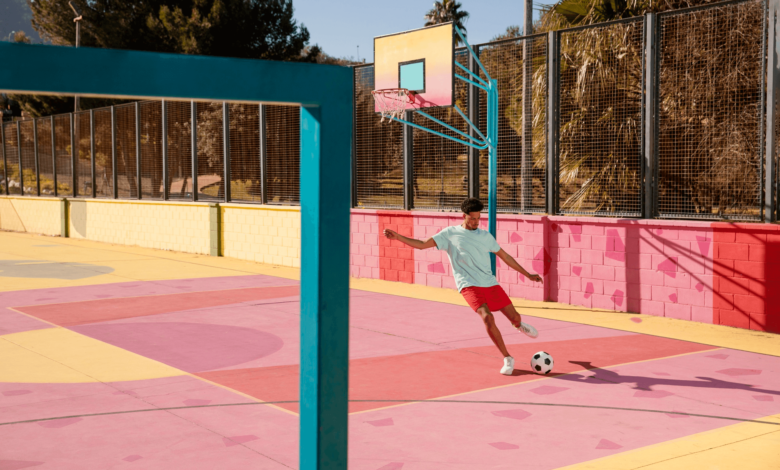
Indoor multi-sport courts require flooring that balances traction, shock absorption, ball rebound, and durability. Rubber sports flooring can provide controlled surface response while supporting athlete movement and gameplay consistency. Proper acoustic treatment, moisture management, and standards-based performance testing further help facility planners select safe, durable flooring for multi-purpose athletic environments.
Key Takeaways
- Balanced Performance: Effective multi-sport flooring combines traction, shock absorption, and ball rebound without compromising movement or stability.
- Athlete Safety: Standards-based friction and force-reduction testing helps evaluate how flooring responds during running, landing, and pivoting.
- Environmental Resilience: Proper subfloor preparation, moisture control, and acoustic design support long-term flooring performance.
- Informed Selection: Product testing, installation specifications, and maintenance requirements should guide flooring decisions for multi-purpose facilities.
Designing an indoor multi-sport court requires more than selecting a durable surface. Flooring must balance traction, impact attenuation, ball rebound, and surface deformation to accommodate different sports, movement patterns, and performance requirements. ASTM F2772-24 evaluates these athletic performance characteristics for multi-purpose indoor sports floor systems.
Rubber sports flooring can be engineered to provide impact attenuation and an appropriate level of surface response, depending on its construction and tested performance. Acoustic characteristics, moisture management, substrate preparation, and installation quality can also influence the flooring system’s long-term performance.
By comparing product-specific test data with relevant flooring standards, facility planners can make more informed choices for versatile indoor athletic environments.
The Science of Multi-Sport Substrates: Friction, Rebound, and Impact Dynamics
Engineering an indoor athletic facility involves addressing competing biomechanical forces. A court designed exclusively for high-energy ball response can compromise impact absorption, subjecting athletes to chronic joint stress. Conversely, an excessively soft surface dampens ball bounce and increases foot fatigue.
Biomechanical Traction vs. Rotational Friction
Surface friction dictates shoe-to-floor engagement during acceleration, deceleration, and pivoting. So, understanding the sliding coefficient is critical when evaluating general rubber sports flooring options.
- If the friction coefficient drops below 80, athletes experience slippage, while if it exceeds 110, sudden rotational stops exert excessive torque on the anterior cruciate ligament (ACL) and ankle joint complexes.
- High-density rubber flooring utilizes specialized surface texturing to maintain consistent friction, enabling predictable lateral movements without compromising kinetic energy.
Force Attenuation and Ball Energy Rebound
Impact absorption measures the ability of a surface to attenuate kinetic shock generated during landing.
- Premium rubber sports flooring leverages point-elastic and combi-elastic properties to absorb energy under foot impact while retaining structural rigidity across broader surface areas.
- It ensures that localized deformation absorbs foot-strike forces while preserving energy for vertical ball response.
- Standard rubber flooring formulations designed for static loads often lack this dual-action compliance, demonstrating why multi-use court design requires engineered elastomeric profiles.
The following table highlights the principal parameters and explains how each can influence surface response, athlete movement, and gameplay consistency.
| Performance Parameter | Relevant Standard / Requirement | Practical & Biomechanical Significance |
| Force Reduction (Shock Absorption) | Performance classes beginning at ≥10% force reduction | Reduces the magnitude of impact forces transmitted through the floor during athletic movement. |
| Surface Friction | 80–110 Pendulum Test Value | Provides a specified level of surface traction, helping balance grip and controlled movement. |
| Ball Rebound | ≥90% relative rebound compared with concrete | Supports consistent ball response for sports such as basketball and volleyball. |
| Vertical Deformation | Requirements vary by floor-system classification; ≤3.5 mm applies to specified point-elastic performance | Controls surface deflection under load, contributing to predictable foot and surface interaction. |
Table: Key Performance Parameters for Indoor Sports Flooring
Acoustic Dampening and Environmental Resilience
Acoustic performance and environmental resilience are essential considerations when selecting sports flooring, as they influence noise control, moisture management, durability, and long-term performance in multi-purpose facilities.
Acoustic Dampening for Multi-Purpose Sports Facilities
High-impact activities such as running, jumping and court sports can produce impact noise and low-frequency structural vibrations, making the acoustic performance of rubber sports flooring a key factor.
- High-density rubber flooring can help absorb impact energy and reduce noise transmission compared with harder surfaces, improving acoustic comfort in schools, gyms, community halls and multi-purpose athletic facilities.
- Selecting an appropriate underlayment, subfloor assembly, and installation method is essential since the overall acoustic performance depends on the complete floor system rather than the rubber surface alone.
Environmental Resilience and Moisture Management
Multi-purpose sports facilities are expected to withstand heavy foot traffic, rolling equipment, temporary event setups, and changing environmental conditions.
- Rubber flooring with low-emission certifications, such as GREENGUARD Gold where applicable, can support healthier indoor environments by limiting emissions from the flooring product.
- Effective moisture management requires appropriate subfloor preparation, vapour testing, compatible adhesives, perimeter detailing and installation practices.
- Controlling moisture transmission from concrete slabs can help reduce the risk of adhesive failure, surface damage, and microbial growth, while proper cleaning and routine maintenance can extend the service life of the sports flooring system.
Case Study: Community Recreation Center Upgrade
A 15,000 sq. ft. multi-purpose community fieldhouse in Southern California was experiencing more athlete ankle sprains and inconsistent basketball rebound from its worn synthetic sheet flooring.
- To improve sports performance and surface consistency, the facility installed an 8mm dual-durometer rubber sports flooring system certified to ASTM F2772 Class 2 standards.
- Post-installation testing recorded a surface friction rating of 95, 93.5% uniform ball rebound, and a 26% reduction in impact force.
- Over an 18-month follow-up, reported lower-limb impact injuries decreased by 34%, while routine floor maintenance costs fell by 22%.
Wrapping Up
Balancing traction, shock absorption, and ball rebound is essential for safe, high-performance indoor courts. With certified surfaces engineered for standardized friction and force attenuation, facility planners protect athletes while ensuring long-term surface durability. Check rigorous testing metrics to create a reliable multi-sport environment tailored to diverse athletic demands.
See also: The Business Impact of Strong Restaurant Branding
Transform Your Athletic Facility with High-Performance, Safety-Tested Surfaces
Contact an experienced sports flooring designer to assess your requirements and get the right flooring system for performance, safety, durability, and long-term maintenance. Check brand reviews and pricing to avoid budget overruns or quality issues.