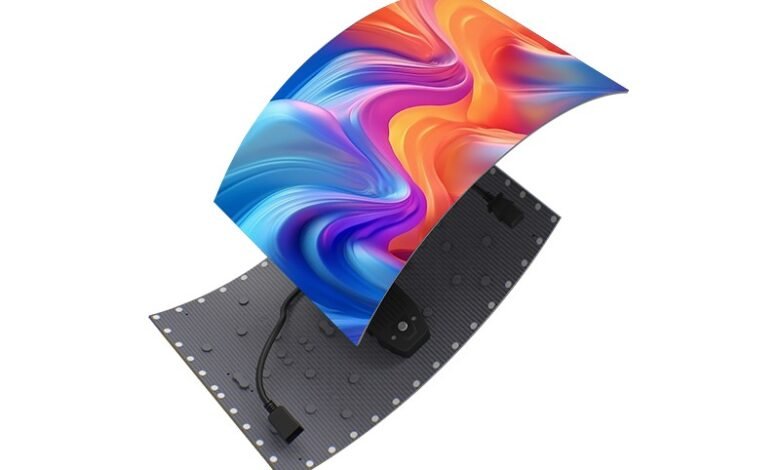
The gap between a display that works and one that truly performs often comes down to the surface it lives on. Flat walls are easy — any panel handles flat. But the most compelling commercial environments aren’t flat. They’re curved, cylindrical, arched, and irregular. That’s precisely where the flexible LED display has moved from niche technology to standard specification across multiple industries.
Adoption has accelerated sharply. The global LED display market is tracking above $14 billion in 2026. Flexible and creative-format displays account for a growing share of new installations. The reason isn’t novelty — it’s utility. When display technology conforms to architecture instead of fighting it, designers gain more creative freedom and installers get cleaner outcomes.
Flexible LED Display in Retail and Commercial Interiors
Retail is where flexible LED display technology has made its most visible commercial impact. Simply put, retail is where the visual stakes are highest.
Curved Storefront and Window Displays
A curved LED screen in a storefront window draws attention in ways that a flat panel cannot. The geometry itself signals something premium and deliberate. Indoor flexible LED modules with pixel pitches of 1.5 mm to 2.5 mm hit the sweet spot for storefront applications. They’re fine enough for high-definition content at a 2–4 meter viewing distance. They’re also flexible enough to wrap the curved glass facades that define modern retail architecture.
Moreover, the installation logic is straightforward. Flexible LED modules use standardized magnetic or snap-on retention systems. As a result, a curved window display can be assembled on-site without custom metalwork or complicated alignment procedures. Retail fit-out timelines are notoriously tight. Therefore, a display system that installs in hours rather than days is a practical advantage that shows up directly in project budgets.
Hotel Lobbies and Luxury Brand Environments
Hotel lobbies and luxury brand showrooms share one specific visual requirement: seamless surfaces. A tiled rigid panel creates visible seam lines at module boundaries. In contrast, a flexible LED screen at a fine pixel pitch eliminates visible joints. The display surface reads as continuous, which is the baseline expectation in environments where premium perception drives the business model.
Furthermore, indoor MIP flexible LED modules use Micro-Integrated Package chip technology to deliver pixel pitches as fine as 0.9 mm. They combine 16-bit color depth with 16.77 million reproducible colors. In a hotel lobby or a luxury brand’s flagship store, that level of color fidelity at close viewing range is what separates a display installation from a display statement.
Flexible LED Display for Entertainment, Stages, and Live Events
No application stresses a flexible LED display more thoroughly than live entertainment. Equally, no application benefits more clearly from the format’s advantages.
Stage backdrops for touring concerts must pack down, travel light, and set up fast at each venue. Flexible LED modules designed for this context weigh as little as 6–8 kg/m² — roughly half the weight of rigid touring modules. They also fold into transport configurations that rigid panels simply can’t achieve. A 300 m² LED backdrop that previously required a dedicated truck now fits in a standard touring trailer.
As a result, visual design possibilities expand proportionally. A flat backdrop is one format. A curved screen that wraps the stage width and curls over the performer is a different visual experience entirely. Flexible LED display technology makes that format practical rather than prohibitively complex.
Exhibition environments benefit similarly. Temporary booths at trade shows use flexible LED screens to build display structures quickly. Teams break them down at the end of the event and redeploy them in different configurations at the next venue. Consistent dimensions and plug-and-play interfaces make this kind of multi-use deployment operationally realistic.
Flexible LED Display on Curved Outdoor Building Facades
The economics of outdoor advertising have shifted significantly. Building facades in high-traffic commercial districts are now treated as media inventory. However, those buildings aren’t designed with flat advertising surfaces in mind.
Outdoor flexible LED displays are specified with IP65 waterproof protection and high-brightness LEDs capable of 5,000–7,500 nits output. They handle the two primary outdoor challenges: weather and sunlight. An anti-glare mask design ensures image legibility even in direct afternoon sun. In addition, the flexible substrate conforms to whatever curvature the building facade presents — whether that’s a gentle single-axis bow or a more pronounced architectural curve.
Building owners have noticed that a curved facade flexible LED display generates more advertiser interest than a flat equivalent. The format commands premium placement rates because it’s visually unmissable at street level. Consequently, the ROI equation for a prime building frontage is increasingly straightforward.
Along highways and major transit corridors, the durability case is equally clear. Outdoor flexible LED modules with magnetic flat-retention design stay stable against wind loading and thermal expansion cycles that would otherwise stress rigid panel mounting systems over time.
Flexible LED Display in Transportation Hubs and Public Infrastructure
Airports, metro systems, and bus terminals share a common spatial challenge. They deal with irregular geometries in high-traffic environments where information clarity is non-negotiable.
At airports, flexible LED displays at boarding gates handle real-time flight information in spaces with curved walls, low ceiling heights, and column-heavy layouts. An indoor flexible LED module adapts to a curved concourse wall or a cylindrical column seamlessly. By comparison, a rigid panel installation would require custom fabrication for every non-flat surface.
In metro systems, platform screens face consistent vibration from passing trains, high humidity, and rapid temperature cycling. Nevertheless, flexible LED modules built to these specifications maintain stable operation under continuous mechanical stress. The flexible substrate absorbs minor structural movement that would fracture rigid module mountings over time.
Additionally, parking structures use LED modules on pillars and low overhead structures to guide vehicle flow. A compact, flexible LED display paired with a real-time parking availability system reduces dwell time in parking lanes and eases peak-hour congestion.
Choosing the Right Flexible LED Display for Each Application
The breadth of flexible LED display applications underscores one operating principle: there is no universal specification. The right product depends entirely on where it’s installed and how it’s used.
Indoor commercial environments prioritize pixel pitch and color fidelity. A retail storefront at 1.5 mm pitch and a hotel lobby at 0.9 mm MIP pitch are both indoor flexible LED displays. However, they serve different visual purposes at different viewing distances.
Outdoor environments, on the other hand, prioritize brightness, weatherproofing, and mechanical durability. Pixel pitches of 2.5 mm to 4 mm are sufficient for the viewing distances involved. As a result, the engineering investment goes into IP ratings and thermal management instead.
Events and entertainment prioritize weight, deployment speed, and repeated reconfiguration. Module standardization — consistent sizing, tool-free installation, and snap-on retention — is the critical spec. A display that’s fast to install and pays for itself across multiple deployments.
Manufacturers who produce flexible LED modules across all three categories typically offer the clearest guidance on specification selection. They’ve engineered solutions for each application type and understand where trade-offs appear in real-world use. Reviewing a manufacturer’s full flexible LED display range — covering indoor MIP modules, standard indoor panels, and outdoor-rated options — gives buyers a comparative baseline that product-by-product research rarely provides.
The industries specifying flexible LED displays in 2026 aren’t treating them as a premium upgrade. They’re choosing them because the installation environment demands it. The technology has matured to the point where performance, reliability, and practical logistics all hold up. That combination is what moves a display format from interesting to standard.