HVAC professionals face persistent challenges that often remain invisible until problems escalate. Hidden leaks buried within wall cavities, stubborn blockages deep inside ductwork, and corrosion forming along inaccessible pipe sections can all compromise system performance and drive up repair costs. Traditional inspection methods frequently require cutting into walls, dismantling duct sections, or relying on guesswork—approaches that waste time and money while risking further damage to the system. Industrial endoscope cameras have emerged as a transformative solution, granting technicians direct visual access to the most confined and hard-to-reach spaces within HVAC installations. These compact, flexible devices illuminate what was previously hidden, turning uncertain diagnostics into confident assessments. So why are industrial endoscope cameras becoming essential equipment for modern HVAC professionals? This article explores their critical role in today’s inspection workflows, examines key features like dual lens technology and high-resolution imaging that elevate diagnostic capability, and provides practical guidance on selecting the right camera to match specific HVAC inspection demands.
The Critical Role of Industrial Endoscope Cameras in Modern HVAC Inspections
For decades, HVAC technicians relied on invasive methods to diagnose hidden problems. Cutting access holes in drywall, disassembling duct runs, or removing ceiling tiles were standard practices just to get eyes on a suspected issue. These approaches carried inherent risks—structural damage, extended labor hours, and the possibility of misidentifying the problem location entirely. Industrial endoscope cameras have fundamentally changed this equation by enabling non-destructive visual inspection through existing openings as small as a quarter inch in diameter.
The efficiency gains are substantial. A technician can thread a flexible camera probe through a supply register, condensate drain port, or small access panel and visually confirm conditions in minutes rather than hours. This speed translates directly into reduced labor costs and faster turnaround for customers. Accuracy improves simultaneously because technicians observe actual conditions rather than inferring them from indirect symptoms like temperature differentials or pressure readings.
The versatility of these cameras spans virtually every HVAC inspection scenario. Technicians use them to examine ductwork interiors for debris accumulation, inspect evaporator and condenser coils for fouling, verify refrigerant line integrity in concealed spaces, and assess drain pan conditions without full unit disassembly. Commercial applications extend to checking fire dampers, verifying insulation integrity, and documenting conditions for compliance reporting. This breadth of capability explains why adoption has accelerated across the industry—from independent residential contractors to large commercial service organizations—as professionals recognize that visual confirmation eliminates costly assumptions and builds client trust through documented evidence.
Essential Features: Dual Lens Inspection and High-Resolution Cameras
Not all endoscope cameras deliver equal value in HVAC applications. The difference between a basic borescope and a purpose-built industrial endoscope camera lies in advanced features that directly address the complexity of HVAC systems. Two capabilities stand out as particularly impactful for technicians working in this field: dual lens inspection technology and high-resolution imaging. Together, these features transform a simple visual probe into a comprehensive diagnostic instrument capable of revealing conditions that single-view, low-resolution cameras routinely miss.
Understanding Dual Lens Inspection for Enhanced HVAC Views
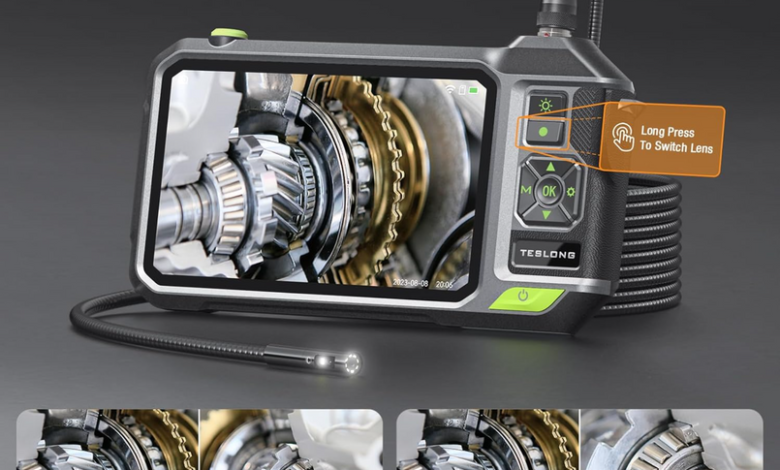
Dual lens technology equips an endoscope camera with two separate optical perspectives—typically a forward-facing view and a side-facing view—accessible without physically repositioning the probe. This matters enormously in HVAC work because ductwork, piping, and equipment interiors present complex geometries filled with bends, T-junctions, and branch connections. A single forward-facing lens can travel straight through a duct run but misses lateral branch takeoffs, side-wall damage, or conditions at perpendicular connections. The side-view lens eliminates these blind spots by capturing imagery along the pipe or duct walls as the probe advances. Technicians inspecting a condensate drain line, for example, can simultaneously check for internal blockages ahead and observe sidewall corrosion or biofilm growth. When navigating duct junctions, switching between views reveals conditions at each branch point without repeated insertions from different access locations. This dual perspective reduces inspection time significantly and ensures comprehensive coverage of complex HVAC geometries in a single pass.
Why High-Resolution Cameras Are Vital for Detecting HVAC Issues
Resolution determines whether a technician can distinguish between a harmless shadow and a hairline crack in a heat exchanger, or differentiate surface condensation from active corrosion on a refrigerant line. High-resolution cameras—typically offering 1080p or higher image quality—capture fine details that lower-resolution alternatives simply cannot render. In HVAC diagnostics, this clarity proves critical when identifying early-stage pitting on copper lines, detecting micro-fractures in furnace heat exchangers, or spotting small mold colonies forming on coil surfaces before they spread. The improved image quality also enhances documentation value; clear, detailed photos and video provide compelling evidence for warranty claims, insurance reports, and customer presentations explaining recommended repairs. When a technician can show a client a crisp image of a corroded joint or debris-clogged coil rather than a blurry approximation, trust builds and repair authorizations follow more readily. High-resolution imaging essentially bridges the gap between seeing a problem and proving it exists.
How to Choose the Right Industrial Endoscope Camera for HVAC Tasks
Selecting an industrial endoscope camera for HVAC work requires more than picking the most feature-packed option available. The right choice depends on matching camera capabilities to the specific demands of your inspection workload. A residential technician primarily checking furnace heat exchangers and condensate lines faces different requirements than a commercial team inspecting large-diameter ductwork across multi-story buildings. By evaluating your needs systematically, you avoid overspending on unnecessary features or—worse—purchasing a camera that falls short when it matters most.
Assessing Your HVAC Inspection Requirements
Start by identifying the typical inspection depth you encounter. Residential systems generally require probe lengths between three and five meters, while commercial installations may demand ten meters or more to reach deep into trunk lines or vertical chases. Next, consider the operating environment. Cameras used near active heating elements or inside boiler flue passages need heat-resistant construction, while those inspecting condensate systems or cooling towers must tolerate sustained moisture exposure without fogging or seal failure. Probe diameter also matters—smaller residential ductwork and tight refrigerant line access points call for probes under six millimeters, whereas larger commercial ducts accommodate bigger camera heads that often deliver superior image quality. Finally, evaluate articulation needs. Systems with multiple bends and tight turns benefit from probes offering tip articulation of 180 degrees or more, allowing the camera to navigate complex routing without binding or losing image orientation.
Model Comparison: Evaluating the Teslong TD450s Camera and Other Options
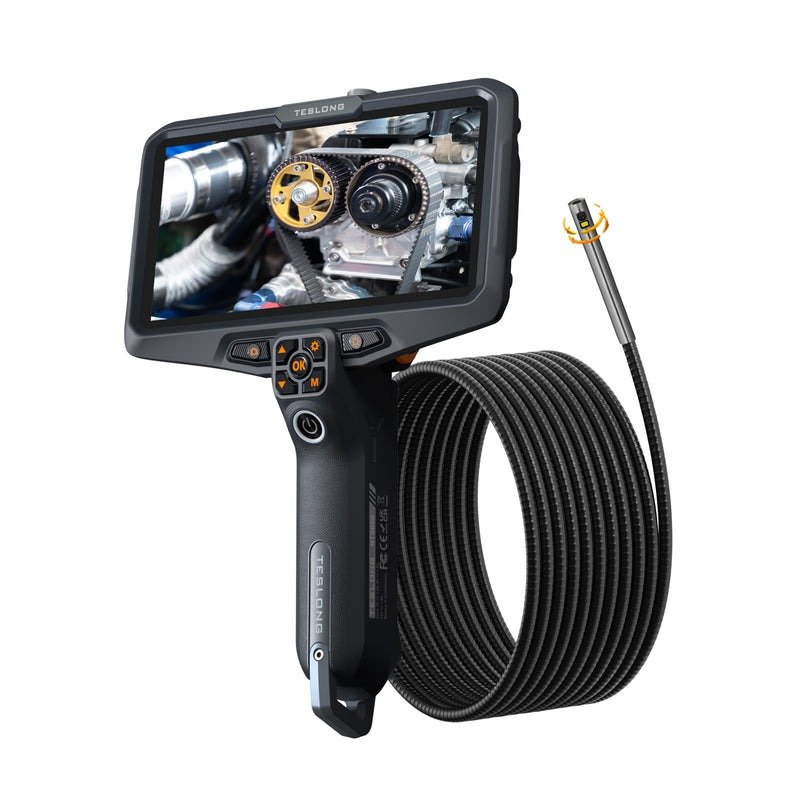
The Teslong TD450s camera illustrates what a purpose-built industrial endoscope brings to HVAC applications. Its dual lens configuration provides both forward and lateral views essential for comprehensive duct and pipe assessment, while its high-resolution sensor captures the fine detail needed to identify early-stage corrosion or micro-cracks. The semi-rigid yet flexible probe design balances pushability through straight runs with enough compliance to navigate bends without damaging delicate components. When comparing the TD450s against alternatives like dedicated plumbing inspection cameras, consider the trade-offs. Plumbing cameras often feature self-leveling heads and longer cable lengths optimized for drain and sewer work, but they typically lack the compact probe diameter and dual-view capability that HVAC confined spaces demand. Conversely, ultra-thin automotive borescopes may fit tight openings but sacrifice durability and illumination power needed in dusty or reflective HVAC environments. The ideal selection balances probe flexibility, image resolution, environmental resistance, and viewing angles against your most frequent inspection scenarios, ensuring the camera serves as a reliable daily tool rather than a specialized device that sits unused between rare applications.
Practical Applications: Leveraging Versatile Cameras for HVAC Success
The true value of industrial endoscope cameras becomes evident in daily fieldwork where adaptability determines whether a job gets completed efficiently or stalls due to diagnostic uncertainty. Consider duct cleaning verification—after a cleaning crew finishes a commercial air handling system, a technician inserts the camera through register openings at multiple points to confirm debris removal and document post-cleaning conditions for the building manager. This visual proof satisfies both quality assurance requirements and client expectations without reopening sealed access panels.
Refrigerant line inspections present another compelling use case. When a system shows signs of capacity loss but no obvious leak appears at accessible fittings, threading a compact camera probe through wall penetrations or ceiling cavities reveals the condition of concealed copper lines—identifying green patina corrosion, kinked sections from settling, or damaged insulation that invites condensation problems. Technicians working on older residential furnaces routinely navigate camera probes through burner compartments to examine heat exchanger surfaces for stress cracks that carbon monoxide can escape through, providing definitive visual evidence that supports replacement recommendations.
Versatile cameras also prove invaluable during preventive maintenance programs. Commercial facilities benefit from scheduled visual inspections of cooling tower fill media, chilled water piping interiors, and VAV box damper mechanisms—all accessible through existing service ports without system shutdown. A single camera system handles these varied tasks because features like adjustable LED intensity accommodate both reflective metal surfaces and dark, light-absorbing duct liner materials. This adaptability means HVAC professionals carry one reliable tool that transitions seamlessly between morning residential service calls and afternoon commercial maintenance routes, maximizing equipment investment while delivering consistent diagnostic confidence across every job type they encounter.
Elevating HVAC Diagnostics With the Right Endoscope Camera
Industrial endoscope cameras have become indispensable for HVAC professionals who demand efficiency, accuracy, and non-destructive diagnostic capability. These tools eliminate the guesswork and invasive methods that once defined the trade, replacing them with direct visual confirmation of conditions hidden deep within ductwork, piping, and equipment assemblies. Features like dual lens inspection technology and high-resolution imaging elevate these cameras from simple viewing devices to comprehensive diagnostic instruments—capturing multiple angles in a single pass and rendering fine details that distinguish early-stage problems from benign conditions. Choosing the right camera requires honest assessment of your inspection workload, from probe length and diameter to environmental resistance and articulation range, ensuring the tool matches the tasks you encounter most frequently. Whether verifying duct cleaning quality, tracing elusive refrigerant leaks, or documenting heat exchanger integrity, a well-chosen endoscope camera pays for itself through faster diagnoses, fewer callbacks, and stronger client relationships built on visual evidence. HVAC professionals who integrate these cameras into their standard toolkit position themselves ahead of competitors still relying on outdated methods—delivering superior service while reducing operational costs across every job.