Why High-Stakes Journalism and Podcasting Now Depend on AudioConvert for Precision Audio to Text Converter Workflows

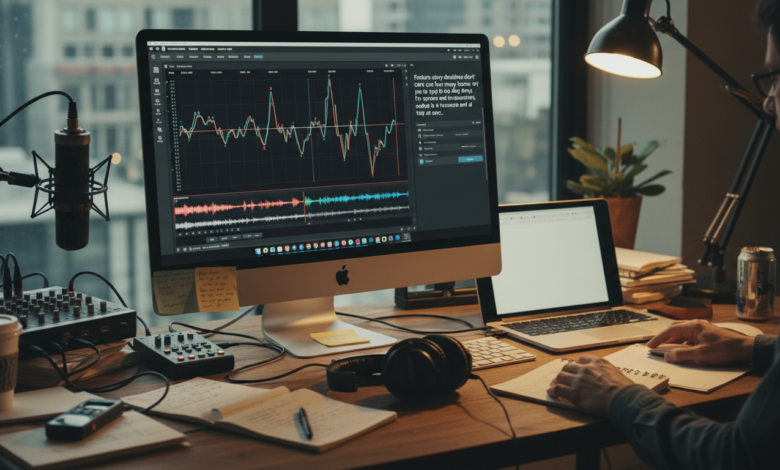
Feature-story deadlines don’t care how many hours of raw tape you’ve got to slog through. For reporters and podcasters, audio is a treasure and a trap at once—the story’s truth lives there, sure, but it’s chained to the grind of linear time. You cannot “skim” a voice recording like you can a document. This fundamental friction is why the shift toward high-fidelity transcription isn’t just a convenience—it is a survival strategy for creators who need to maintain a high output without sacrificing the granular accuracy that professional ethics demand.
The Shift from Recording to Reporting
In the field, the primary challenge isn’t capturing the sound; it’s the cognitive load of organizing it later. I have observed that the most effective reporters are moving away from the “re-listen and type” model because it creates a bottleneck that delays the actual synthesis of information. By using a modern audio to text converter, the workflow becomes non-linear. You are no longer tethered to the start and end of a recording; instead, you gain a searchable map of the conversation that allows you to jump directly to the moments of highest tension or clarity.
The Psychology of the Searchable Interview
There is a distinct mental shift that occurs when you see an interview as a text file for the first time. It shifts from a hazy, here‑then‑gone chat into something you can grab—a tangible dataset. For a podcaster, that means you can check—right now—whether a guest said “millions” or “billions,” a tiny word with outsized stakes in money and politics. Being able to query your own tape on the spot takes the edge off editing, so you can chase the story arc instead of worrying about botching a quote.
Identifying the “Golden Quote” in Seconds
Most strong podcast episodes or features lean on two or three “golden quotes”—the moments when a speaker lets their guard slip and says something startlingly honest or sharp. Finding these in a three-hour raw file is like looking for a needle in a haystack. An audio to text converter functions as a magnet in this scenario. By scanning the text for keywords or emotional markers, you can isolate these clips in seconds, ensuring your show notes and social teasers lead with the most compelling content available.
Engineering Engagement Through Text-Based Show Notes
Podcasters often underestimate how much of their “listener” base actually finds them through text. Google’s crawlers are remarkably sophisticated, but they still prioritize written data over audio waves. If you want your show to be more than a closed loop for the folks already listening, you’ve gotta give people a doorway in. Turning episodes into rich transcripts and shaping up show notes is hands‑down the easiest way to lower the gate for newcomers who search topics, not your show’s name.
Beyond Simple Transcription: The AI Summary Advantage
The jump from a raw transcript to a publishable “Program Note” is often the hardest part of the post-production cycle. I’ve found that using AI-driven summaries allows a producer to see the forest for the trees. When the tool spits out a bird’s‑eye take on the themes, it doubles as a second editor, nudging a blog structure you might’ve missed from being knee‑deep in the material. It trims an hour of ramble into five or six punchy, usable bullets that actually keep a reader hooked.
Managing Multimedia Assets in a Unified Pipeline
Creative work rarely exists in a vacuum. A journalist covering a story often handles a mix of audio interviews, site photos, and video clips. If you are working on a multimedia package, the efficiency of your tools determines your sanity. For example, when preparing video teasers for a podcast on a tight bandwidth budget, using a video compressor becomes a tactical necessity to ensure high-quality previews can be uploaded and shared instantly. This level of technical hygiene ensures that the logistics of file management never slow down the momentum of the story.
Navigating the Pressures of Real-Time News Cycles
For today’s journalist, the “tight deadline” isn’t a day anymore—it’s more like 24 minutes. When news is breaking, you don’t have hours to wait on old‑school transcription services. You need a solution that processes at the speed of the internet. The goal is to move from “audio recorded” to “tweetable quote” in the shortest possible window. This speed doesn’t just help with social media; it allows for faster fact-checking against other sources, which is the only way to maintain credibility in a high-velocity information environment.
Speaker Recognition and the Panel Discussion Paradox
One of the most complex tasks in audio production is transcribing a roundtable or a panel. Without clear speaker diarization, the transcript becomes a confusing muddle of voices. Modern AI has gotten scary good at picking out each speaker’s unique voiceprint. For town halls or pressers with officials talking over each other, that’s a genuine game‑changer. You get a clean log of who said what—crucial when the work might face legal eyes or a tough edit.
The Nuance of Accents and Technical Jargon
I’ve often heard skepticism regarding AI’s ability to handle regional accents or deep industry slang. However, my research into these tools suggests that the latest models are trained on such diverse datasets that they often outperform human transcribers who might not be familiar with a specific niche. Whether it’s a deep-tech interview about semiconductors or a local story with heavy regional dialects, the audio to text converter acts as a bridge, normalizing the text into a format that is readable while still preserving the original intent and phrasing of the speaker.
The ROI of Integrated Transcription Workflows
In the end, picking a top‑tier transcription tool is an ROI call—not only dollars, but your hours. If a tool saves a producer four hours per episode, that’s four hours freed for booking, sound polish, or digging into the story. Quality climbs when people spend time on the truly human bits—and let the machine chew through the repetitive conversion.
Building a Long-Term Searchable Archive
Most creators think about transcription in terms of the next deadline, but the real value is in the archive. Imagine being able to search through five years of interviews for every time a guest mentioned “sustainability.” You only get that kind of data leverage if you’ve gone all‑in on a text‑first workflow. It lets you spin old work into new shapes—books, courses, retro episodes—with nearly no friction. It turns your past work into a searchable database that continues to provide value long after the original air date.
Scaling Your Content Without Scaling Your Stress
The fear for many independent creators is that “going big” means “working more.” By automating the transcription and summarization process, you decouple your growth from your hours worked. You can produce more content, reach more platforms, and provide better accessibility without needing to hire a full-time assistant. It’s about working smarter within the constraints of the digital age, ensuring that your voice is heard, read, and discovered across the entire landscape of the modern web.